
Police leadership insight workshops
In-depth research with Police staff to support successful implement the Leadership Development Programme and embed leadership behaviours across all levels of the Police force.
More +


Building Trust and Motivation to Report Crime
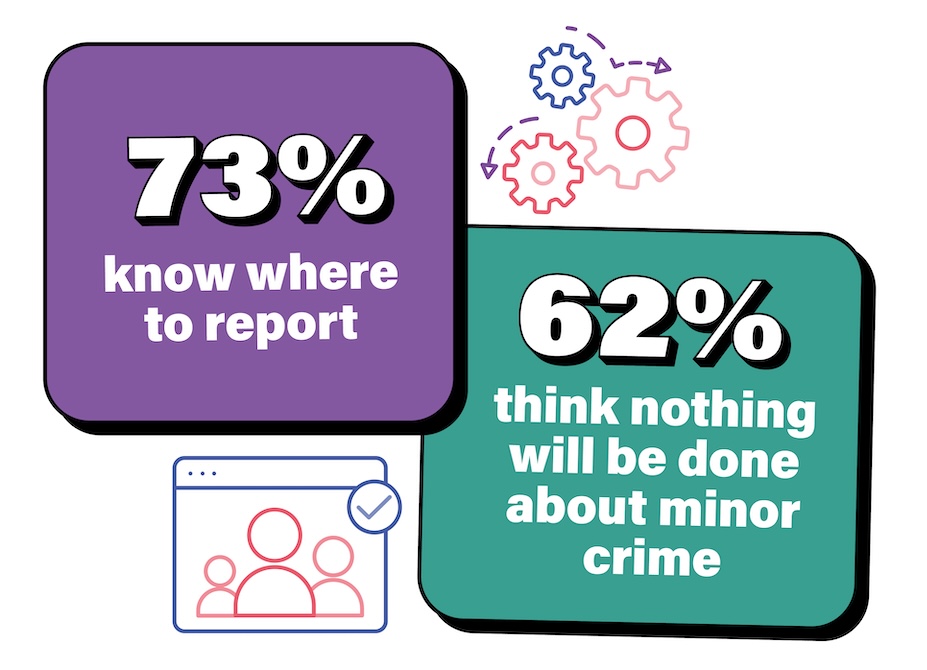
Cambridgeshire Constabulary aimed to increase community intelligence reporting by 2-3% each year, acknowledging that comprehensive crime reporting enables proactive policing, resource allocation, and the dismantling of significant organised crime networks. Our objective was to build an evidence base informed by behavioural science to better understand the barriers and motivators that influence public reporting behaviours. Rather than focusing on accessibility alone, we aimed to uncover the psychological, social, and motivational factors that determine whether residents actually choose to report incidents, particularly lower-level crimes like antisocial behaviour.

Why are people not reporting?
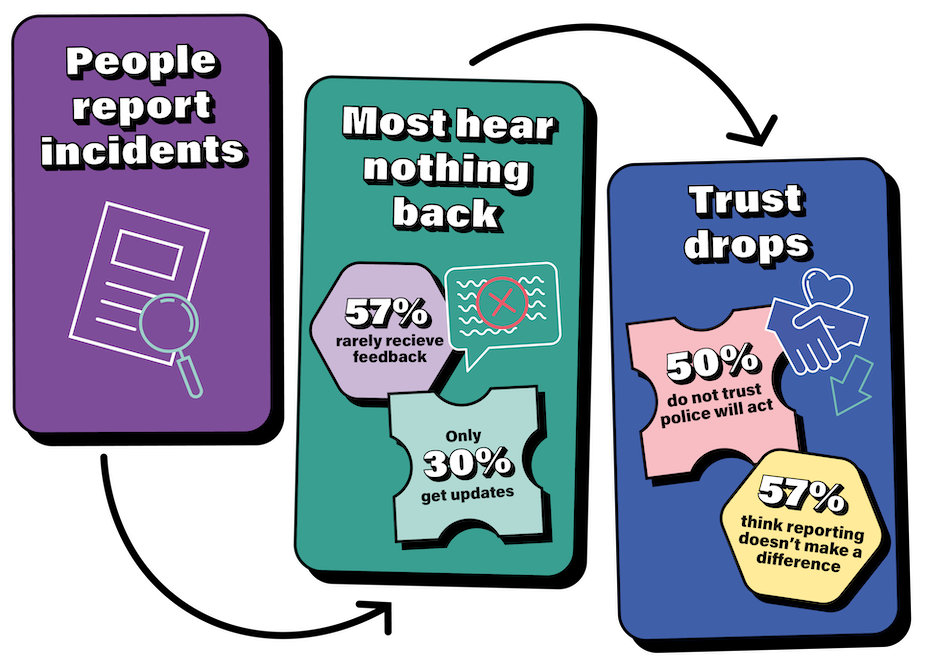
We conducted an online insights survey reaching 1,779 residents across Cambridgeshire. The research revealed that while 93% of residents believe everyone should report incidents and 90% recognise their personal responsibility to do so, actual reporting behaviour falls far short of these intentions. Through thematic analysis informed by behavioural science frameworks including COM-B, we identified 3 behavioural insights: residents stop reporting because they never see follow-up (learned helplessness), many fear wasting police time and filter incidents themselves (information avoidance), and for minor crimes, the perceived personal cost of reporting, such as time, effort and doubts about impact, often outweigh both the practical and moral benefits, including their sense of civic duty (expectancy-value theory).
From Research to Sustainable Behaviour Change
From our research findings and behavioural science frameworks, we developed 12 targeted recommendations interventions addressing the fundamental trust and motivation barriers preventing residents from reporting, particularly for lower-level crimes. Proposed interventions addressed the lack of feedback residents often experience after reporting, through automated status updates, clear guidance on reportable incidents and campaigns demonstrating that minor reports lead to major outcomes. This was in addition to making reporting visible through monthly statistics and community testimonials, establishing that reporting is normal and valued behaviour. By addressing the intention-action gap where residents hold strong beliefs about reporting yet don't follow through, these evidence-based interventions will enable Cambridgeshire Constabulary to rebuild public trust, increase reporting volumes, and establish collaborative community-police relationships essential for sustained community safety outcomes.
In-depth research with Police staff to support successful implement the Leadership Development Programme and embed leadership behaviours across all levels of the Police force.
More +
Research to understand public confidence in and perceptions of police visibility in Cambridgeshire.
More +
We used our skills to support British Gypsum in creating a Local Communities programme and promoting it.
More +By entering your email address, you agree to be added to our mailing list.
We respect your privacy.
We never sell data.
Unsubscribe anytime.