If you've worked in sustainability, behaviour change or public engagement for any length of time, you've probably seen the same pattern play out more than once. A campaign is launched. New communications are developed. People are given information about the issue and encouraged to make different choices. Awareness increases, at least for a while. Yet when the dust settles, the actual behaviour often looks remarkably similar to what was happening before. You’ve addressed the awareness and education gap – for now. But you haven’t moved many people towards actual behaviour change.  

This isn't because people don't care. Let’s take waste as an example. Most people understand that reducing waste is a good thing. They recognise the importance of saving energy, recycling correctly or making more sustainable choices. The challenge is that behaviour is rarely driven by information alone. People make decisions within systems. Those decisions are influenced by habits, social norms, competing priorities, convenience, incentives and the environments around them. Understanding something and acting on it are not always the same thing. 

That realisation has shaped much of modern behaviour change practice. Rather than starting with the assumption that people simply need more information, we have to look at what is preventing or enabling a behaviour in the first place, which can be services, environments, incentives, social influences and the way choices are designed. 

Image for How to deliver behaviour change that lasts

This shift can be seen in the development of the Four Es – a framework developed by UK Government to help deliver behaviour change By the early 2000s, organisations such as DEFRA were grappling with the problem we have highlighted. Significant investment had gone into public awareness campaigns over many years covering everything from household waste to energy efficiency and sustainable lifestyles. Knowledge was increasing, but behaviour wasn't always changing at the same pace. 

The question became increasingly difficult to ignore: if information isn't enough, what else needs to happen?  

One response was DEFRA’s Four Es framework, which helped shift attention away from communication alone and towards the wider conditions that influence behaviour. Although it emerged from sustainability and environmental policy, its principles remain relevant to almost any organisation trying to encourage change today. 

Where the Four Es Came From 

One of the most important contributions of the Four Es framework was that it challenged a simple but persistent assumption: that people will naturally make better decisions once they have enough information. 

In reality, behaviour is rarely that straightforward. People are more likely to adopt new behaviours when practical barriers have been removed, when they can see others doing the same thing, when the behaviour feels worthwhile and when the organisations promoting change demonstrate the same commitment themselves. 

Image for How to deliver behaviour change that lasts

The Four Es provided a way of thinking about these different influences. 

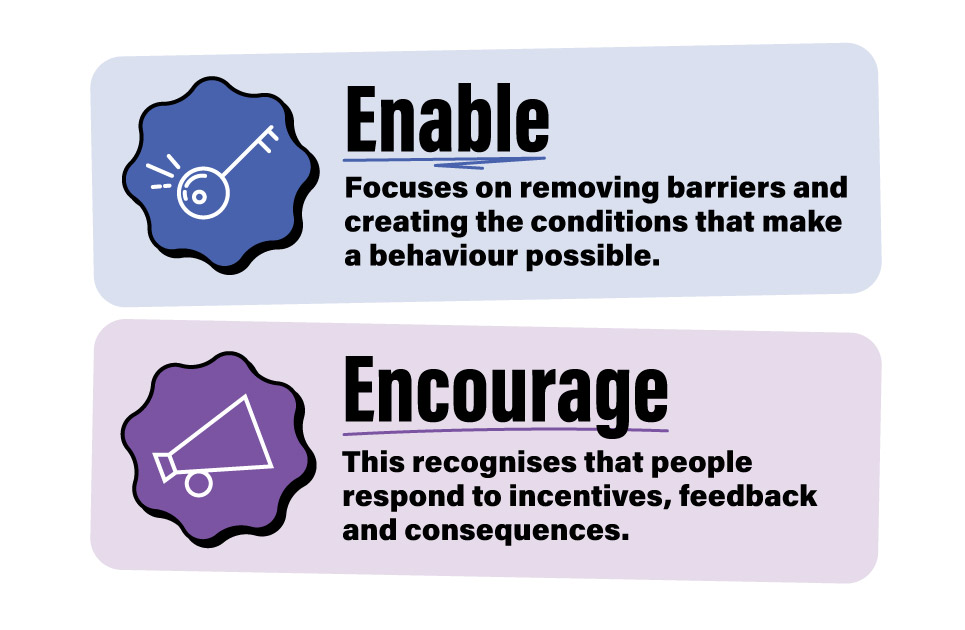
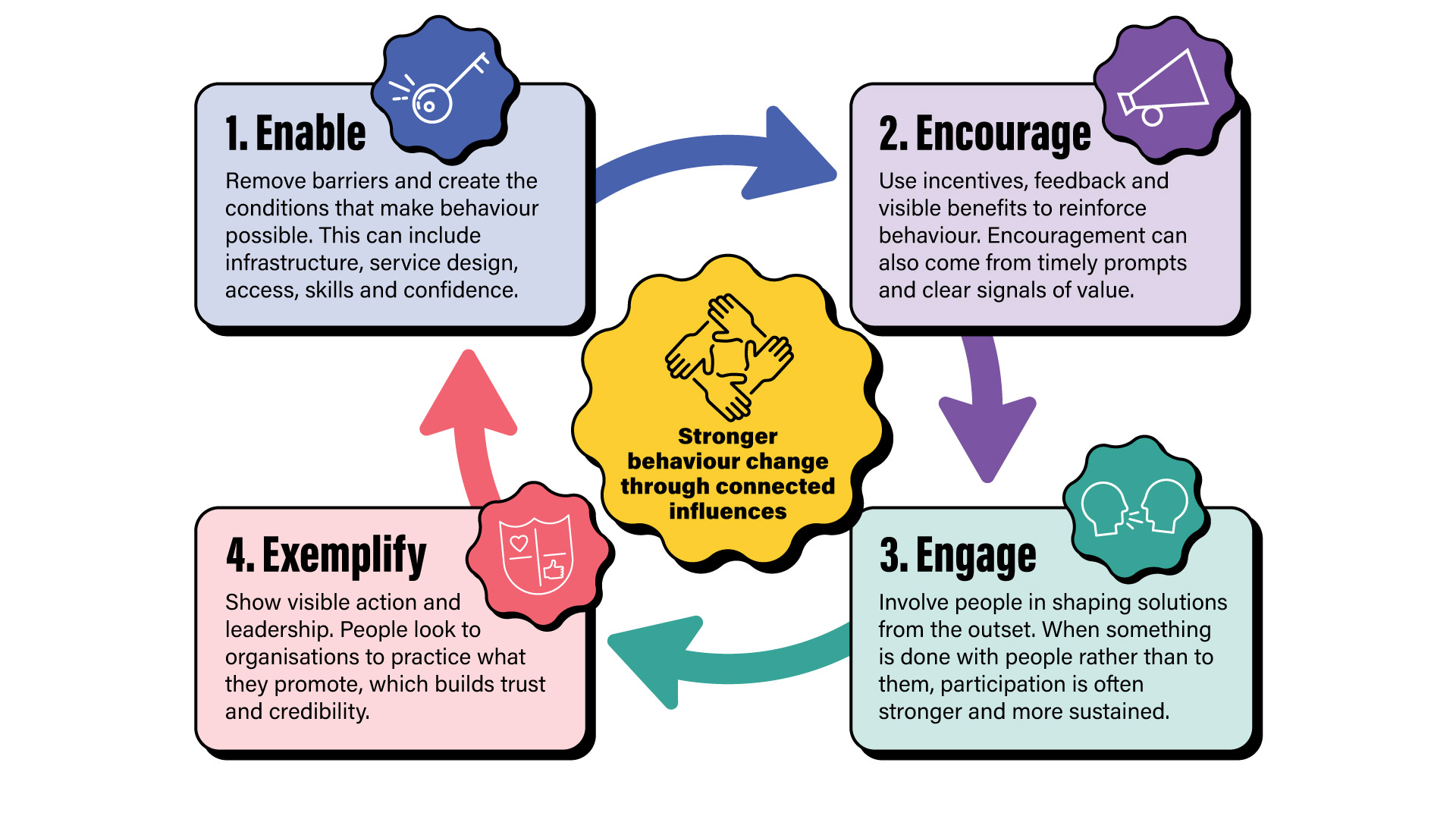
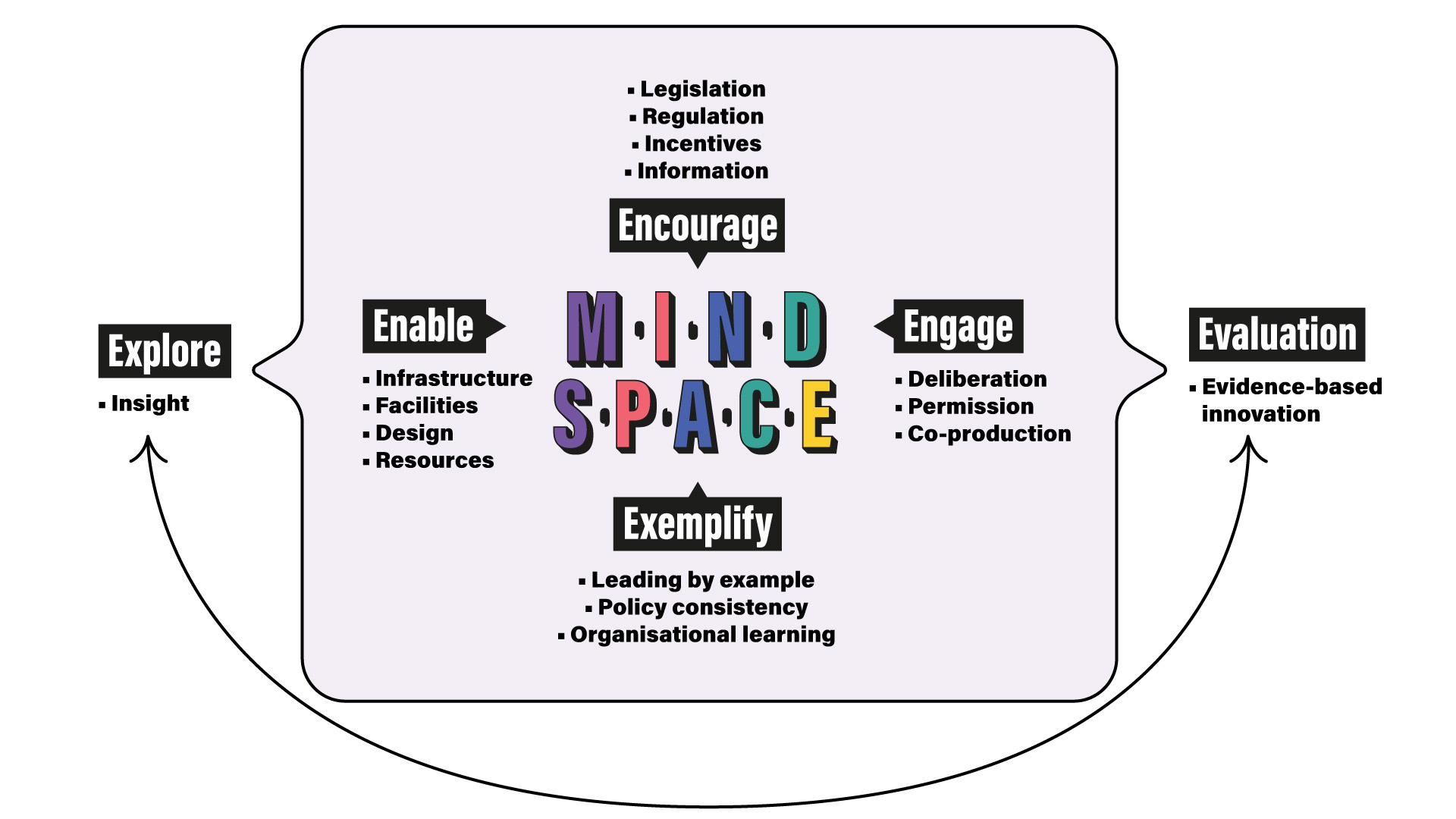
The first element, Enable, focuses on removing barriers and creating the conditions that make a behaviour possible. That might mean providing infrastructure, redesigning services, improving access or helping people develop the skills and confidence they need to act. If the desired behaviour is difficult, inconvenient or confusing, even the most persuasive campaign is unlikely to succeed. 

The second element is Encourage. This recognises that people respond to incentives, feedback and consequences. Encouragement isn't only about rewards. It can involve making benefits more visible, providing timely feedback or creating signals that reinforce the value of a particular behaviour. 

Image for How to deliver behaviour change that lasts

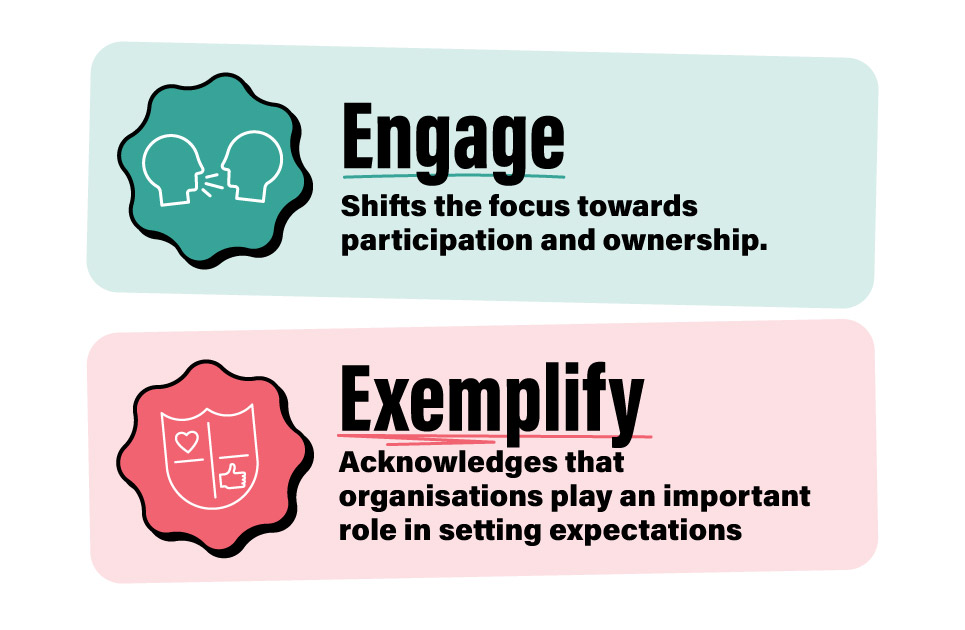
Engage shifts the focus towards participation and ownership. Rather than designing programmes in isolation and communicating them afterwards, it encourages organisations to involve people in shaping solutions from the outset. When individuals feel that something is being done with them rather than to them, participation is often stronger and more sustained. 

The final element, Exemplify, acknowledges that organisations play an important role in setting expectations. People pay close attention to whether institutions practise what they promote. Policies and campaigns tend to carry greater credibility when they are supported by visible action and leadership. 

The 4 E's Framework

A way of thinking about the different influences on behaviour

Image for How to deliver behaviour change that lasts

Taken individually, none of these ideas are particularly radical. Their strength comes from being considered together. The framework encouraged practitioners to think beyond awareness raising and consider the wider environment in which behaviour takes place. 

That shift may seem obvious now, but at the time it represented an important departure from the traditional campaign-led approach that dominated much environmental communication. More importantly, it laid the foundations for many of the behaviour change frameworks that followed. 

Image for How to deliver behaviour change that lasts

The Four Es in Action

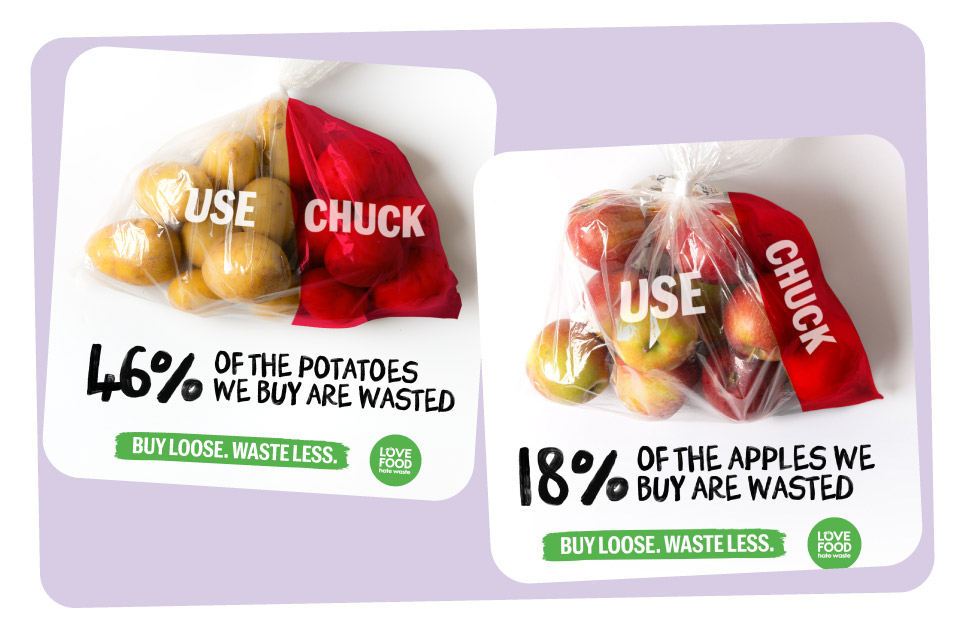
Frameworks are useful, but their value ultimately depends on whether they help people to solve real life problems. Love Food Hate Waste is a good example of what the Four Es can look like in practice. 

Created by WRAP, Love Food Hate Waste is a national campaign aimed at reducing the amount of food wasted in UK homes. Rather than simply raising awareness that food waste is a problem, the campaign has focused on helping people change the everyday behaviours that contribute to it, from planning and portioning to storing food correctly and making better use of leftovers. 

Image for How to deliver behaviour change that lasts

The approach reflects the Four Es in different ways. 

Enable: Love Food Hate Waste provides practical tools and advice that make reducing food waste easier. This has included guidance on portion sizes, food storage, recipes and using leftovers, alongside activities delivered through local communities and partners. 

Encourage: The campaign makes the benefits of reducing food waste visible and personally relevant. Saving money has been an important part of this, alongside the wider environmental benefits of wasting less food. 

Engage: WRAP has worked with local authorities, businesses, community organisations and other trusted partners to take food waste messages into communities. Rather than relying on one national communications campaign, this allows people to encounter advice and activities through organisations and groups they already engage with. 

Exemplify: Local authorities and other partners also have a role in demonstrating the behaviours they are encouraging. The Four Es approach asks organisations to look at their own practices and show visible commitment to the change they are asking others to make. 

What makes Love Food Hate Waste useful as an example is that it goes beyond simply telling people that wasting food is bad. It combines information with practical support, relevant benefits, community involvement and action from the organisations delivering the programme. 

That combination is central to the Four Es. Behaviour change rarely happens because of a single message or campaign. It is more likely when organisations address several of the factors influencing behaviour at the same time and create conditions that make the desired action easier and more worthwhile. But while the Four Es offered a useful way to think about the mix of interventions needed, it did not necessarily answer two other important questions: how do you know which barriers need addressing in the first place, and how do you know whether the intervention has actually worked? 

Where the Four Es fell short, and then evolved 

As the Four Es became more widely used across local government, housing, sustainability and public health programmes, practitioners began to notice a recurring challenge. The framework was helpful for thinking about the types of intervention that might be needed, but it was less helpful when it came to deciding where to begin. 

In many cases, organisations would move quickly into designing solutions. They would launch engagement activities, introduce incentives, improve services or develop communications materials. Sometimes those interventions worked. Sometimes they didn't. When they failed, it was often difficult to understand why. 

The issue wasn't usually a lack of effort. More often, it was a lack of diagnosis. 

Too many programmes were built around assumptions about behaviour rather than evidence. People believed they understood the barriers because they seemed obvious. Residents weren't recycling because they didn't care. Staff weren't switching off equipment because they needed more information. Customers weren't adopting a service because they didn't understand the benefits. Sometimes those explanations were correct. Often they weren't. 

Anyone who has worked in behaviour change for long enough will recognise this pattern. The reason people give for a behaviour is not always the reason that behaviour persists. What appears to be a knowledge problem may actually be an infrastructure problem. What looks like a motivation issue may be driven by social norms or competing priorities. Without understanding the behaviour properly, even well-designed interventions can miss the mark. 

Practitioners increasingly recognised that successful programmes needed a more deliberate starting point. Before deciding how to encourage a behaviour, organisations first needed to understand what was driving it. Equally, there was a growing recognition that many programmes lacked a meaningful ending. 

Projects would be delivered, targets would be reported and funding would come to an end. Yet there was often little evaluation of what had genuinely influenced behaviour and what had simply happened alongside it. Organisations knew what activities had been delivered, but they were less certain about which elements had actually made a difference. As a result, valuable learning was frequently lost. 

The next programme would begin with many of the same assumptions as the previous one, repeating approaches that may or may not have been effective. Over time, many practitioners began adding two further stages to the process: Explore and Evaluate. 

Explore came first. Rather than jumping immediately to solutions, organisations would spend time understanding the behaviour itself. They would gather evidence, speak to the people involved, identify barriers and examine the context in which decisions were being made. 

Evaluate came at the end. Instead of measuring activity alone, organisations would assess whether behaviour had actually changed, what had contributed to that change and what could be improved next time. 

Together, these additions transformed the framework from a set of intervention types into something closer to a continuous improvement cycle. The process became less about delivering a campaign and more about understanding, testing, learning and refining over time. 

That shift reflected a broader change happening across the behaviour change field. Practitioners were becoming increasingly interested not just in what interventions to deliver, but in how people make decisions in the first place. 

And that's where frameworks such as MINDSPACE began to add another layer of insight. 

Image for How to deliver behaviour change that lasts

Where MINDSPACE Fits 

Explore and Evaluate strengthened the process by helping organisations understand behaviour before designing solutions and learn from what happened afterwards. MINDSPACE adds a different layer. It helps organisations think about the small but important influences that shape how people make decisions. 

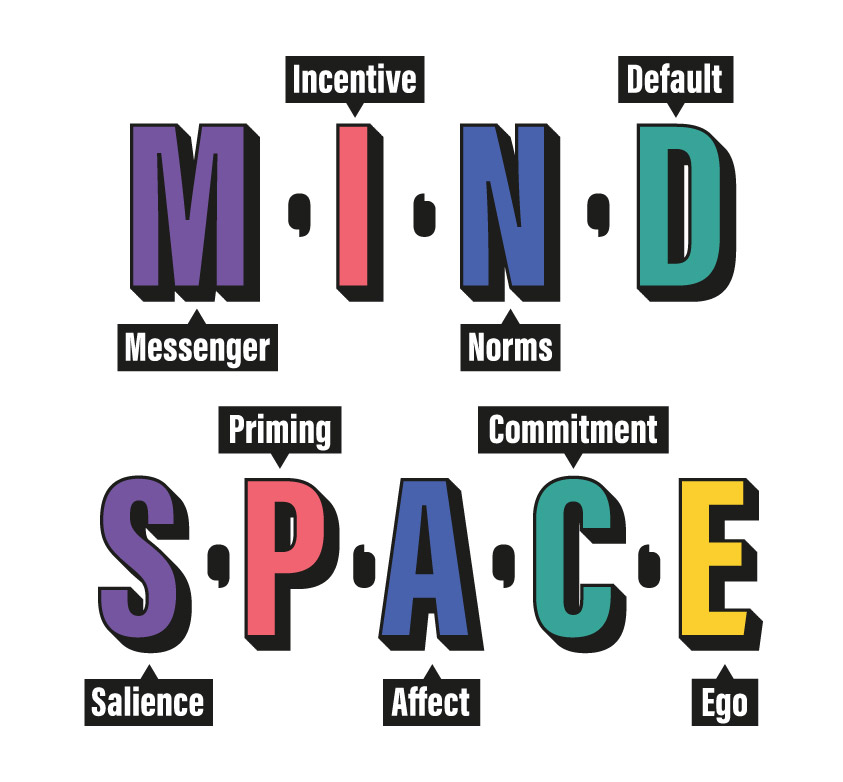
Developed by the Cabinet Office and the Institute for Government, MINDSPACE brought together a range of behavioural influences that shape decisions, often without people consciously realising it. The framework highlighted something behavioural scientists had known for some time: people don't always make decisions through careful analysis. Instead, choices are heavily influenced by context, habits, social cues and the way options are presented. 

Many of these influences will feel familiar. People are more likely to follow the lead of someone they trust than someone they don't. They tend to look to others when deciding what is normal behaviour. They often stick with default options rather than actively choosing alternatives. Even small changes to how a choice is presented can have a significant impact on what people decide to do. 

Image for How to deliver behaviour change that lasts

The Four Es and MINDSPACE therefore play different roles, but they work well together. The Four Es help structure the overall behaviour change strategy by asking whether an organisation is enabling, encouraging, engaging and exemplifying the behaviour it wants to support.  

MINDSPACE can then help shape how those actions are designed. For example, if an organisation wants to enable a behaviour, it might make the desired option the default or make the process simpler. If it wants to engage people, it might use trusted local voices rather than relying only on messages from an organisation. If it wants to encourage action, it might show that other people are already doing it, make the benefits more visible or connect the behaviour to something people care about. 

In other words, the Four Es help identify the types of action that may be needed, while MINDSPACE provides insight into how those actions can be designed in ways that align with how people actually behave. 

From Frameworks to Real-World Change 

One of the most valuable lessons from the evolution of the Four Es is that behaviour change rarely happens because people receive more information. Most organisations already communicate extensively. Staff receive guidance. Residents receive information. Customers are told about the benefits of making different choices. 

Sometimes that works. More often, behaviour is shaped by factors that sit beyond awareness alone. Practical barriers, social expectations, habits, competing priorities and organisational culture can all have a greater influence than information itself. That's why successful behaviour change programmes tend to begin with understanding rather than solutions. Before designing interventions, organisations need to understand who they are trying to influence, what is driving current behaviour and where the real barriers sit. 

Only then can frameworks such as the Four Es, the Six Es [with Explore and Evaluate added] and MINDSPACE be used effectively. They are valuable tools, but they work best when they are applied to real evidence rather than assumptions. 

For organisations working on sustainability challenges, whether that's reducing waste, encouraging energy-saving behaviours, improving participation in environmental initiatives or supporting more sustainable everyday decisions, the principles remain the same. The goal is not simply to tell people what to do. It's to create the conditions that make the desired behaviour easier, more attractive and more likely to stick. 

At Social Change, we help organisations understand the behaviours that matter most, identify the barriers influencing them and design evidence-based interventions that create measurable change. Our work spans waste, water, energy and wider sustainability challenges, combining behavioural science with practical delivery to help organisations move from good intentions to meaningful outcomes. 

To find out more about our work, visit Social Change's Water, Waste and Energy expertise.