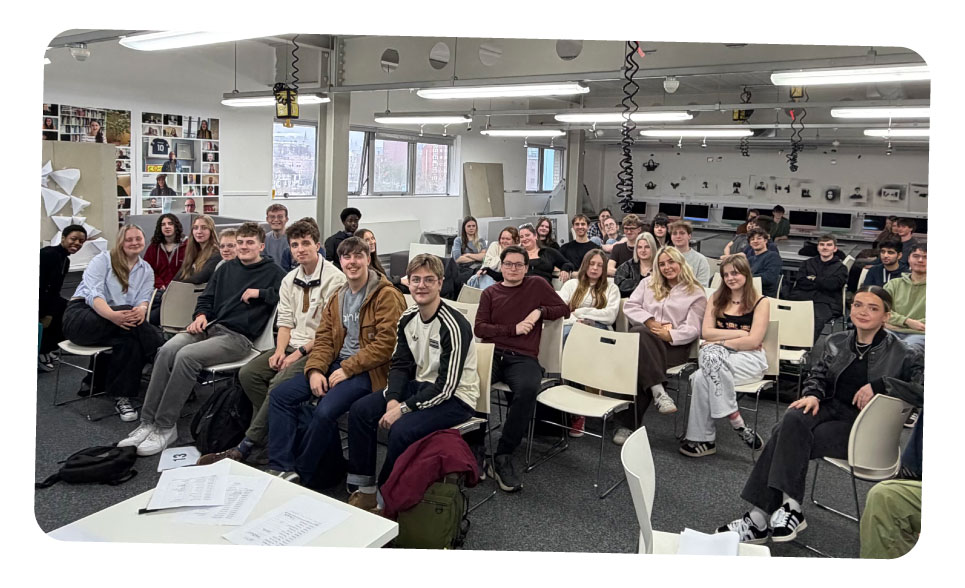

In her talk, Kelly emphasised the need for designers to consider human behaviour in the design of products and services, and ensuring a full and well-rounded understanding of people and how they live their lives is necessary to avoid well-intended but ineffective interventions coming to market that don’t really fit real lives.

UK social issues — like poor mental health, loneliness, the housing crisis and food poverty and insecurity were just some of the issues students were asked to understand before coming up with potential design ideas for change.

Image for Young people can – and should – design for change

Kelly said:

“Students were given very little time to come up with ideas to tackle tough social issues but managed to pitch some really good ideas that could be road tested and piloted tomorrow. I was really impressed with the pitches and it made me think how important it is for young people to be at the table helping to solve societal issues and designing their future society”.

Here are 10 ideas that were pitched by students:

  1. Busline – an app for Bus travel that helps people navigate the bus network [similar to Trainline] to encourage greater use
  2. Redesigning the experience of travelling by bus – the bus could bring people together more than it currently does, and be a space for entertainment and connection helping to alleviate loneliness
  3. Affordable Housing locator – an app or website to help people locate where affordable housing is in the UK
  4. An app for families to connect their calendars and arrange dates and times to call and meet each other in our busy and physically disconnected world
  5. Upgrading our train infrastructure to run on greener and cheaper energy to help reduce the costs of train travel
  6. An app for young people to help them understand their credit score with transparency on how to improve it and seeing that improvement in real time through gamification

7. A permanent space inside supermarkets for discounted food with a short shelf life to help reduce food waste and marketing this space in a way that makes consumers feel like heroes and not stigmatised for choosing discounted or free food.
8. An app that helps people to create meals with leftover food – just put in the ingredients and let the AI do the work.
9. Intergenerational community spaces to help reduce loneliness and isolation
10. A goal setting app to help people with depression get up and outside doing things that will positively impact their life – small steps to begin
11. A timer app that is present when you use social media [in the corner] to tell you how much time you are on social which helps to raise awareness and alarm on how much time you are wasting.

During the pitches, Kelly talked about how you can ‘design in’ frictions to get people to reduce or stop a behaviour that might not be desirable – such as spending a long time on social media. Ideas from students included making it difficult to ‘doom scroll’ by timing you out and making people sign back in every 30 minutes.

‘Designing out’ frictions was also discussed as a way to make behaviours easier to take up. Many of the students acknowledged that some societal ‘problems’ and the current efforts to solve them actually don’t need new products or services – they just need to be improved and re-designed to make them work better for people and society.